Showing posts with label simplicity. Show all posts

Wednesday, March 23, 2011

Sick Day Hot Toddy


I haven't been sick enough to miss work since coming down with norovirus in 2006. Since easing myself onto a natural, organic diet some years ago, I've not been sick at all, and I have to admit I've taken a smug pride in the fact that I never get sick.

Pride goeth before the fall.

I write this near 7 pm on a Wednesday, after spending the entire day in bed - and a shame too, it looked like such a pretty day out. When I realized I was in no shape to go to work, due to this debilitating chest cold I picked up (after, mind you, eating processed foods at work again), I thought I'd get some writing done and maybe straighten up the house. HA. I haven't been able to stay vertical for more than five minutes at a time, and I've spent the vast majority of the day sleeping.

It's working though. I'm still not feeling great, but I feel a bit better than I did this morning. So I thought I'd share the best chest-cold remedy I know: the spiced brandy toddy. It'll help you get better in a hurry, and without a lot of scary drugs with all their side effects. Take one before you go to bed and you'll feel a little better, so you can go to sleep and let your body do the work of healing.

SICK DAY BRANDY TODDY

½ a fresh lemon
1 oz brandy, bourbon, or rum
1 Tbsp raw apple cider vinegar
1 Tbsp raw honey
½ tsp cinnamon
¼ tsp cayenne pepper
Simmering water

Squeeze all the juice out of the lemon half into a large mug. Drop a chunk of the rind in, if you like. Add the liquor, ACV, honey, cinnamon, and pepper. Top off with simmering water and stir until honey is melted and contents are evenly blended. Sip immediately while it's still quite hot.

Here's why it works:

The hot water soothes your throat, and also helps to raise your body temperature so your immune system doesn't have to work as hard to kill the infection. (Remember that we get fevers because heat kills off certain infections.) It's also psychologically soothing.

Honey coats your throat a bit, easing the pain and raspy feeling. It's also a powerful antimicrobial - you can treat minor eye infections with raw honey - which also helps to fight the infection. And it sweetens the taste of the other flavors, which might not be so enjoyable together otherwise.

Lemon is loaded with vitamin C, which we all know is a powerful immune-booster. The acid in the lemon juice and ACV also works to break up phlegm and clear your throat.

You can skip the raw apple cider vinegar if you really want, but its health benefits are many and it really does work. If you don't want to drink it, you can put some on a cotton ball and rub it on your chest, under your nose, and on your forehead. It works a bit like Vick's, but in my opinion it smells better and it's better for you. It doesn't taste bad in the toddy, either - it blends right in with the lemon.

Cinnamon tastes nice too, and it also has antimicrobial properties. The cayenne can also be skipped, but its flavor is unobtrusive and it helps if you're having sinus problems; we all know how spice can clear your head. I also find that a bit of cayenne helps to numb a sore throat.

And that brandy/bourbon/rum? It's soothing and helps you go to sleep, so that your body can work harder on fighting off the infection. If you don't buy it, remember that alcohol is also a key ingredient in NyQuil - but a nice hot toddy tastes a lot better.

And now I'm going back to bed. Wish someone was here to bring me some chicken soup.

Monday, March 7, 2011

Blackeyed Peas, Demystified


The back page of each issue of Organic Gardening magazine is given to an article by the magazine's editor, Maria Rodale. Her grandfather J. I. Rodale is widely considered to be the founder of the modern organic gardening movement; gardening and produce are still, after publishing, the family business. Presumably, Maria grew up around a wide variety of vegetables. So I was stunned to read this article, in which she described a vacation to a B&B near Nashville, where she was treated to "something they called peas." These weird little beans didn't resemble any peas she'd ever heard of, so she inquired and got an education on field peas - including the most famous of field peas, the symbol of the South, the blackeyed pea.

The article reminded me of a time two years ago when a friend from New York was visiting us and checked out the pantry as I made dinner. "What's this?" she asked, picking up a jar. "These funny little beans with the spot that looks like an A?"

Until then, I'd assumed that blackeyed peas were on a level with cornbread and ham. Sure, they're Southern, but everyone knows about them, right? Wrong, it turns out! I mentioned them on Twitter not too long ago when someone asked about a healthy standard weeknight supper, and I was asked repeatedly to explain blackeyed peas and how to cook them.

So here it is. Blackeyed peas are pretty hard to screw up, but with a rich, smoky molasses they can be so much more delicious than their humble nature implies. They're packed with protein, calcium, folate, and vitamin A, among other benefits. They're dirt-cheap and store for a very long time, so you can stock up and always have plenty on hand. They bring you luck when eaten on New Year's Day. They don't even need to be pre-soaked. And don't be fooled by Southern stereotypes - blackeyed peas do NOT need pork, or even any meat at all.

And the best part: They're at their best when left alone in a crockpot all day while you go to work. For an easy and nutritious weeknight supper, throw blackeyed peas in the crockpot before you leave in the morning, and then whip up a quick honey cornbread (here's my recipe) when you get home. Collard greens and copper pennies, as in the pic above, are nice but optional!

MOLASSES BLACKEYED PEAS

1 cup dried blackeye peas
4 cups chicken/vegetable broth, water, or a combo
2 cloves minced garlic
¼ cup molasses
2 Tbsp balsamic vinegar or cider vinegar
1 Tbsp toasted sesame oil (see note)
1 tsp salt
1 tsp hot sauce
½ tsp crushed red pepper
½ tsp dried savory or parsley (optional)
¼ tsp ground black pepper

Chopped green onion, to taste

Note: You can use olive oil, but if you have toasted sesame oil, definitely use it here.

Rinse off the blackeyed peas in a strainer. If you see any shriveled-looking or darkened peas (or little pebbles, sometimes it happens), toss them.

Combine everything but the green onion in the crockpot and switch it on. The measurements don't need to be exact. Forget about it for 8-10 hours. Come home and give it a stir, and when the cornbread is ready, dish up those peas and sprinkle green onion on top.

If you're not making any other dishes and this is just a simple blackeyed-peas-and-cornbread dinner, try a pickle and/or some sliced radishes on the side. Raw veggies really sing with this, or sometimes I go the other way and have a few cubes of cheese. Just keep it simple!

Wednesday, February 23, 2011

Homemade Bacon, Homegrown Eggs: Carbonara as it was meant to be.


We ate this spaghetti squash alla carbonara two nights in a row, and would've had it again if we'd had more spaghetti squash. I'd call Charcutepalooza #2 a rousing success.

After curing sweet and savory bacon in the fridge for over a week, I borrowed a friend's smoker and some applewood chips, and fired the whole thing up in my garage since the day was drizzly (I left the garage door open, but it still smells like bacon in there). The cured pork belly sat in the smoker for four hours, at which point I moved it to a 200° F oven to finish off.

I noticed that before I smoked it, when I first removed the pork belly from the cure, it was kind of greyish and not that beautiful bacony pink. I was disappointed at first, but hoped that smoking would pink it up. Sure enough, when it came out of the smoker, I had this:


Michael Ruhlman, in his excellent book Charcuterie (which is the official textbook for Charcutepalooza), says to let the bacon cool to room temperature but adds, "Try a piece now though, straight out of the oven - it's irresistible." He's absolutely right. It was incredible. I shared a piece with Anne, my new roommate and half the genius of Fab Frugal Food, and we both had to stop ourselves from devouring the whole thing. While she ran out to buy a spaghetti squash, I found myself trimming the fatty skin off the bacon slabs while still hot, and chewing on that skin to suck out the warm, fresh bacon fat. So much for that Jewish Guilt.

That very night, we had to try using the bacon. So I put the maple-brown sugar bacon away for another use, and cut some of the savory bacon into lardons. Anne is currently on a grain-free diet, but I wanted to try a carbonara, so we went with a spaghetti squash recipe that Anne calls "low-carb-onara."


I can't find the recipe on Fab Frugal Food anymore to link to it, but I took some liberties with it anyway. I fried the lardons with a handful of garlic and some chopped fresh rosemary and thyme from the yard. Anne roasted the spaghetti squash and then raked it up with a fork until it perfectly resembled its namesake; it went into the pan with the bacon and garlic, while I whipped up three egg whites with one yolk, reserving the other two yolks on a plate. (We used one egg from each of my hens, now that all three are finally laying again.) I beat a ton of parmesan into the egg mixture, then tossed the squash and bacon with it, gave it plenty of pepper...

...and then we dished it up with pine nuts, fresh parsley, and a single yolk on top of each serving, mixing the raw yolk into the spaghetti squash to make a creamy sauce. Obviously I wouldn't recommend doing this with storebought eggs, but real carbonara is definitely a perk of raising my own chickens. I love this stuff. And with my homemade, flavorful, extra-tasty bacon cut thick into lardons... ohhhh my. Any word I could use in any tongue would be painfully inadequate.


So Teenage Jewish Vegetarian Kimberly can huff off to her room and slam the door all she wants. I plan to start another batch of bacon this week. I'm moving on to the next phase of Charcutepalooza too - look for homemade corned beef next month, mmm! - but I think homemade bacon is going to be a regular thing around our house. I've never put anything this delicious in my mouth before and I want it all the time.

As for the spaghetti squash, I liked it better than the usual pasta. It had more texture, and its mild flavor complemented the carbonara really well. It wasn't as slippery as pasta, so it held the sauce better, and its nutritional content was way higher than noodles would've been. Score another point for gluten-free!

And what about the maple-brown sugar bacon I made? I fried up a little last night just to taste it, and it's a sticky-sweet-salty concoction that just begs to be used in a pie. Maple Bacon Cream Pie, my specialty, seems obvious, but I feel like a taste of home. So tonight, it's Elvis Pie. A graham cracker crust with butter and bacon fat, with a creamy peanut butter layer on the bottom, topped with a lucious banana cream filling, then garnished with vanilla sweetened whipped cream and chunks of this sweet-salty bacon. I can't wait.

Monday, February 14, 2011

Charcutepalooza: Homemade Bacon


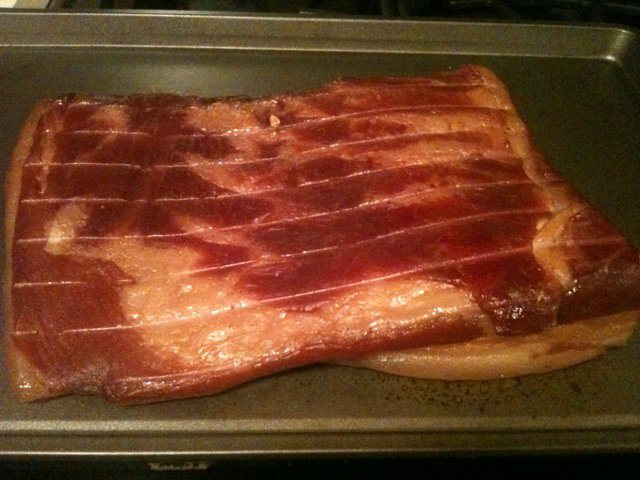
See that there? That is a Big Darn Slab of Pork Belly. In my kitchen.

I've previously alluded to my Jewish baggage when it comes to pork, shellfish, and the like. Round one of Charcutepalooza, with its duck prosciutto, was a fun experiment in food preservation without any of the conflict that I knew would be coming eventually. I was secretly pleased, though, when bacon came up so soon. If I'm going to eat pork, it might as well be bacon, that darling of all the current culinary fads, that mascot of Portland cuisine.

I've made a few tentative forays into bacon over the past few months (including the recently mentioned maple bacon cream pie) and found the good-quality stuff to be a pleasure worth indulgence. So it was with a naughty excitement akin to a date at the swingers' club that I headed out into Portland last week and purchased that thick slab of piggy sin that you see above.

I also needed curing salt, and was fortunate enough to find a carrier here in town so I didn't need to mail order it. This salt has nitrates and nitrites added to facilitate proper curing; in small doses this is safe to eat, but it's dyed a frightening cotton-candy pink so no one accidentally cooks with too much of it. I only needed a couple ounces, but as it was so cheap ($1.50/lb), I went ahead and bought a pound of it in anticipation of future Charcutepalooza endeavors.


I had to go to a warehouse near the waterfront, in the Southeast Industrial District, to get it. As I stood at the counter waiting for the heavily-tattooed man to return with it, another employee came to the front to ring me up. "That's it?" he asked with perfunctory professionalism. "Just the pound of cure?"

With a Brysonesque smile I volunteered, "It's worth an ounce of prevention!"

He blinked, faltered for a second, and shrugged. "Uh, okay. That's a dollar fifty."

My cheeks remarkably similar in color to the curing salt now in my hand, I paid the man in quarters and dignity, and fled for my Kia and NPR. They'd get my jokes on NPR, I thought wistfully.

So I got my illicit pleasures home, consulted Michael Ruhlman's recipe in Charcuterie, and decided to try two kinds of bacon. After whipping up the "basic cure," a combination of kosher salt, curing salt, and sugar, I divided the pork belly into two chunks, one about twice the size of the other. About two thirds of the total went into a sweet cure with brown sugar, maple syrup, and a bit of nutmeg; the remainder went savory, with peppercorns, thyme, oregano, and rosemary, and I'm thinking of cubing that one into lardons when it's finished. Both are now curing in my fridge.


I've been turning them over once a day since Wednesday, and this Saturday they should be ready to smoke. They can be finished in the oven at low heat, but what's the point of bacon without smoke? I have a friend who owns a smoker and is keen to let me use it in exchange for some of the meat.

I think we'll smoke it this Saturday. After all, my friend works during the week, so that's when he's available. And if I'm going to be a bad Jew, I might as well go all the way; no point being half-assed about it. Bring on the Sabbath and let me light that fire.

This bacon better be worth it.

Monday, January 31, 2011

Charcutepalooza: Duck Prosciutto


I promise, I have had a lot going on besides Charcutepalooza. But dangit, Charcutepalooza is the fun one of all my current projects! And finally today we got to enjoy its benefits.

The duck prosciutto was ready last week, but we were busy and only had time to try a little nibble. Our duck breasts had quite a bit of fat on them, which wasn't so good to eat straight, but I learned I could trim it off and use it to give an amazing richness to a pot of beans. Beyond that, we wrapped up the duck prosciutto and stashed it in the freezer for a better day.

Today was that day, and I decided that if you can't have a fancy appetizer for breakfast sometimes, then you aren't really living. I've always seen pork prosciutto served in thin slices wrapped around chunks of melon... and I got to thinking that the sweeter acidity of a mango would go nicely with our juniper-cured duck prosciutto.

The great thing about having frozen the prosciutto: It was easier to slice it very thin. And by the time I had the mango peeled and cubed, those thin slivers of duck had thawed out. So I just wrapped them up and plonked them on a pretty dish, and we nibbled our mango-prosciutto bites with our fingers over the newspaper. I had coffee because I'm a junkie, but Keith had his with peppermint tea, and in retrospect I bet that was really lovely with the fruit and duck.

So that's project one of Charcutepalooza, and I still have plenty of home-cured duck prosciutto in the freezer. (I'm thinking I need to chunk some of it up in the spring and make a pasta dish with duck prosciutto and the first little green peas from my garden.) Next up is homemade bacon, and I was out pricing pork belly for that today.

It's funny how cooking expands your horizons. Five years ago, I was in Hollywood experimenting with new produce from the Sunday farmers' market at Sunset and Vine. Three years ago, I was new in Portland and beginning to try my Grandmother's old freezing rituals and planning my garden. Two years ago, my dabbling interest in canning took off into an ever-growing epic that now consumes my summers and allows me to go Christmas shopping in my own pantry. One year ago, I started making cheese. And now that I've nailed down the science and craft of freezing and canning, my preservation inclinations are coming to include charcuterie. Not bad for a former-vegetarian urbanite.

And I find the more I learn, the less I know, and I like it that way. This way I always get to keep on learning! Now, on to that pork belly...

Saturday, January 22, 2011

Duck Prosciutto!


Pressed for time at the moment, but I had to share a pic. My home-cured duck breast prosciutto is ready to eat! We tried a little bite - it's delicious. Later in the week I have several recipes I'd like to try, but I'm sure at some point we'll just have it with a little cheese and fruit for a light supper.

On to the next charcuterie project soon, which will be homemade BACON. Eep!

Tuesday, January 18, 2011

You know it's fresh and organic when...

Farmers' markets are mostly closed this time of year, so we get our produce from a nonprofit cooperative grocery, People's Co-Op. Besides free yoga, excellent prices on bulk goods, and other benefits, we love this place because everything in the store is all-natural and organic.

One of the quirks to eating the way we do is that sometimes a funny thing happens. You go to the store and get your groceries - in January, that includes a lot of kale, an incredibly nutritious green that is sweetest and most delicious during the coldest weather - and stick it in the fridge when you get home. A couple days later, you're starting to cook and you pull out some kale, only to discover that somebody else got a head start on your dinner.


The Very Hungry Caterpillar went right on eating kale in the bowl we keep for vegetable scraps, and then once the bowl was full, he went out with those veggie scraps to the chickens. Snack and be snacked!

Saturday, January 15, 2011

Crustless Quiche


I cleaned out the fridge the other day and had some leftovers to use up - a bunch of wilting chard, two little strips of salted duck meat that I had to trim off when making prosciutto, heels of cheeses, etc. My first thought was quiche (it usually is), but with health, weight loss, and time concerns, I didn't want to make a crust for it. Thank heaven for crustless quiche.

It's good for you, it's delicious, and it's one of the easiest things you can make (especially in the field of pie). You can clean out your fridge and throw in whatever you have; even leftover broccoli would work. If you don't have time to caramelize the onions and your meat is already cooked (or you aren't using meat), just throw in some green onions or shallots. Quiche is so flexible!

CLEAN-OUT-THE-FRIDGE CRUSTLESS QUICHE
serves 4

2 Tbsp butter, divided
1 Tbsp olive oil
½ small onion, finely chopped
½ cup meat of your choice, cut into small cubes (optional)
1 ¼ cup grated medium cheese (cheddar, gouda, mozzarella, etc.), divided
1 bunch spinach, chard, or kale (washed, dried, and chopped)
3 eggs
1 cup milk
2 Tbsp flour (wheat or gluten-free)
1 Tbsp chopped fresh rosemary (or 1 tsp dried)
1 Tbsp chopped fresh thyme (or 1 tsp dried)
½ tsp Dijon mustard (optional)
¼ tsp nutmeg
Salt and pepper to taste
2 Tbsp Parmesan cheese
1 tsp paprika

Coat the inside of a pie plate or 9-10" casserole dish with 1 Tbsp butter, then spread ¼ cup cheese over the bottom. Set aside. Preheat the oven to 400 F.

In a small skillet, melt the remaining butter with olive oil on medium heat. Add the onion and saute until it starts to soften. Add the meat and continue cooking about 5 minutes or until onions are light golden and beginning to caramelize, and meat is cooked. (If the meat's already cooked, wait until the onions are done and then just stir it in.)

Meanwhile, dump the greens into the food processor and pulse until finely chopped. Add the remaining 1 cup cheese, eggs, milk, flour, herbs, mustard, nutmeg, salt, and pepper. Pulse a few more times until everything is blended. Pour in the caramelized onions and meat, along with the butter and olive oil they cooked in, and give it a quick pulse or two just to stir. Pour into the prepared pie plate or casserole and spread out evenly. (It won't look very pretty. That's okay.)

Sprinkle the Parmesan and paprika over the top and bake for 30-40 minutes, or until a knife inserted in the center comes out clean. Cool for 10 minutes or so (while you whip up a salad to go with it, perhaps) and cut into wedges for serving.

Charcutepalooza Kickoff: Duck Prosciutto!

This year I'm joining somewhere between 50-100 (depending on who I see on Twitter) in a project called Charcutepalooza: A Year of Charcuterie.

Charcuterie, for those who may be unfamiliar with it, is a French term for the art of meat preservation. It covers such time-honored processes as smoking, salting, and curing, resulting in everything from bacon to terrine to confit. Typically it involves pork (there goes that Jewish guilt again), but it doesn't always.

We're taking on a different meat preservation project every month to, as blogger Mrs. Wheelbarrow puts it, "celebrate the appropriate, thoughtful consumption of meat with a year long exploration of the age old craft of charcuterie."

This month our first project was duck breast prosciutto (an Italian term for ham). The recipe comes, as all our recipes will, from Mark Ruhlman's gorgeous book Charcuterie: The Craft of Salting, Smoking, and Curing.

Today's the day for everyone's prosciutto posts, but unfortunately mine isn't quite ready yet. The butcher was out of duck breasts (partially my fault, as we had duck breast for our Christmas dinner) and I had to wait while he ordered me one. Once I got it though, I was surprised by how easy the recipe was. I split the duck breast and buried the two halves in salt overnight...


...then I seasoned them with white pepper and spices. One of the breasts has been sprinkled with black smoked sea salt for a hint of smokey flavor, while the other I seasoned with juniper for an Oregonian twist. Keith helped me tie them up in cheesecloth, where they're now hanging in the garage.


It's been fun so far to follow everyone else participating. Twitter has been bursting with off-color jokes about hanging breasts, husbands protecting our breasts, etc.; a few gung-ho kitchen goddesses are finished already and have been sharing delicious stories of snacks and dinners based on their duck breast prosciutto.

Mine still has a few more days to hang, but so far the temperatures and humidity have been just right for it in the garage. I'm surprised meat preservation isn't more popular, if it's always this easy. Salt and time do all the work! And when I'm done, I'll have two pounds of lucious home-cured prosciutto to use in a thousand different ways.

I just checked out prices for good duck prosciutto and found it going for four times the price of my duck breasts and salt. Somehow, frugality and a renewed contact with thoughtful, time-honored preservation methods make the thought of this prosciutto even more delicious.

I can't wait to try it.


Monday, January 10, 2011

We Got Crabs.


That joke never gets old, does it?

I don't usually do shellfish as a general rule. I like it - well, some of it - but I've got this combination of Jewish obligation and Catholic guilt that makes me feel like I'm doing something perverted whenever I eat shrimp. So I steer clear and give in only when I know it's going to be worth it.

I knew it would be worth it at the farmers' market a few weeks ago. It was the week before Christmas, the last market of the season before they close up for three whole months, and the vendors were doing their best to unload whatever they had left. Keith and I had done our shopping and were trudging back to the car when we passed a couple of fishmongers who were advertising local Dungeness crabs for $3 a pound. We bought two huge fresh crabs for under $5.

When we got home, we were busy with a lot of Christmas preparations, so we stuck the crabs in the freezer. A couple days ago, Keith was itching to cook them up, so he did. I was way too intimidated to do it myself - but no longer. It was quite easy, just a little messy but worth it. Last night we were at the grocery store and Keith found a tub of Dungeness crab meat for $25; he figures it contained about the same amount of meat as we got from these two crabs. We only had to work a little for it - but then, that was fun too, sitting down at the table to crack the legs and dig out the meat while nibbling little bites of risotto.

I made the risotto while Keith cooked the crabs. It's a pretty simple one, but I added the minced peel and some juice from my salt-preserved Meyer lemons, and I also stirred in some fresh parsley and a three-year aged parmesan Keith picked up in southern Oregon. I didn't have any good chicken stock to work with, and I complained that the risotto was bland before I added the lemon and parsley... but once they were in, wow! What a difference. It went great with the crab.

So well, in fact, that the next morning I combined the leftover risotto, leftover crab meat, and an egg, and then I melted the leftover clarified butter and fried up little crab-risotto patties for breakfast.


Sometimes guilty pleasures can be the very best kind.

Monday, January 3, 2011

Baby, It's Cold Outside!

Before I start laying out my plans for 2011, I have to share the last day of 2010. The morning of New Year's Eve found me selling pie again, as I whipped up some salted lavender caramel tarts for a friend who stopped by to pick them up for her family's New Year's dinner. It was a gorgeous day, if a frighteningly cold one - I don't think it got above freezing that day at all - and I wanted to get out, so Keith and I bundled our coats and scarves into the car and headed for Mt. Hood.


We didn't go all the way to the top of the mountain, since we had to chain up pretty early on. Three feet of fresh snow had recently fallen, and the sun was shining on a perfect New Year's Eve, so we parked as soon as we could to frolic in the thigh-deep snow.


I'm still Southern enough that snow REALLY excites me. I've traveled a lot and lived in a variety of places, but I've never lived in a snowy area, and even in Portland snow is a rarity. So the chance to get up to the mountain and see all the lovely firs in the glittering snow, well, that always makes for a pretty awesome day. We spent most of the afternoon snow tubing and had a fabulous time while getting in some exercise.


Once off the mountain, we made a spontaneous decision to drop by Lauro, our favorite special-occasion restaurant, for a fabulous dinner, and then we crossed the street to Pix Patisserie for dessert. We had a bottle of champagne someone had given us for Xmas, and the plan was to take it to the top of Mt. Tabor to toast the New Year under the trees while overlooking the Portland skyline, but it was about 20° F with a sharp biting wind, so we went on home to a warm crackling fire instead.

So now I'm finally getting a chance to sit down and have my New Year's assessment of the year before and year to come - well, I'm still in the middle of it, but it took me a couple days into the year to find the time to start! This year is already off to a busy beginning, and it's loaded with new projects.

I'm figuring out my sewing machine, for one thing; I've made some curtains and tote bags, and am currently working on a more complex project that was supposed to be a Christmas present for a friend but may wind up being a "friendship present" in another week or two. (Oops.) Once I finish this one, I'm going to make myself a couple of girly aprons and then ease myself into clothing (my ultimate goal) with a simple wrap skirt or two. So far sewing is a lot like cooking; my early blundering attempts are kind of cute in their incompetence, and I can tell this will be easy once I get in a lot more practice.

In other news, just to see how crazy I can make myself with project-juggling, I decided to go ahead with an idea I entertained over the summer. Over at my newest blog, Dinner With the World, I'll be documenting my attempt to learn more about my global neighbors and the unique variations of global cuisine as I cook a meal from every country in the world in one year. This should be a pretty interesting read, since I'll be juggling unfamiliar ingredients, a nominal commitment to kosher restrictions, and an effort to stick to seasonal Oregonian produce.

Oh yeah, and I'll also be juggling a business startup. After cultivating a dream of entrepreneurship for most of my life, it's finally time to make it happen. I'm currently saving up for a unique twist on Portland's food cart phenomenon, and have already begun selling my butter-flaky pies to friends and coworkers. By spring, I hope to be out there in the world, slinging pie to the masses. Learn more over at PortlandPiecycle.com (website operable, but still under construction).

Meanwhile, I'll be participating in Charcutepalooza 2011, a multiblog project wherein we'll all revive the lost arts of meat preservation. It's a logical next step after slaughtering chickens last year (and we're actually raising meat birds for real this summer!), and an especially hilarious development for this former PETA member and 12-year vegetarian. We're tackling one meat project per month, with the first up being duck proscuitto. I checked out Michael Ruhlman's book on Charcuterie from the library and can't wait to get started!

I'm also hoping to revamp this blog a bit, improve my photography and rework the design, but that's going to have to wait a few more weeks at least. It also looks as though I may be cowriting a cookbook later in the year - stay tuned for more on that project.

And of course, novels and screenplays await completion, along with the mountain of books I still need to read.

With a to-do list like this one, who needs resolutions?

Sunday, December 26, 2010

Boxing Day

I slept late today and, besides making a big breakfast for Keith and his dad, I've accomplished almost nothing. It's great.

Yesterday's Christmas Dinner was so fabulous I just have to share a picture of it:


That's pan-seared duck breast with red wine and cherry sauce, artichoke hearts au gratin (with gruyere cheese), kohlrabi-fennel salad with capers in a lemon-Dijon vinaigrette, rosemary roasted root vegetables, and steamed broccoli with garlic, butter, and olive oil.

And for dessert, a lightly orangey cranberry pie, served with homemade egg nog ice cream:


Keith and I made dinner together and had a great time, while his dad and a couple of our friends hung out in the kitchen chatting. We played music and had an enjoyable day that culminated in a delicious feast, then ended on movies and a nice hard sleep. Really, isn't that what Christmas is all about?

I'll be back to posting soon, especially as I tackle sewing and some other new projects in the coming year. But first, I'm going to digest all this food and spend today at the arcade goofing off. I've earned it!

Saturday, December 11, 2010

Turkey-Leek Pie (with vegetarian option)


In the winter, I often make this vegetarian leek-artichoke pie with excellent results. Today I was craving it, and I had some leeks, but I didn't have any artichoke hearts. So I dug around in the fridge and improvised, taking the opportunity to use some of the huge gallon bag of turkey I had left over from Thanksgiving weekend (we froze most of it, but I had some I'd thawed this week). The result - even better than the original.

And with this crust, it's unbelieveably simple. You don't even have to roll the crust out or dirty up a bowl! It really is "easy as pie." Make it gluten-free with brown rice flour instead of wheat, if that's your thing.

To make it vegetarian, just leave out the turkey and throw in another cup of veggies - artichoke hearts are great, obviously, but so are potatoes or even beans. You could throw in some chunks of frozen tofu as well, and I was just thinking how good pine nuts would be. If you want to leave the egg out, just increase the milk to a full cup. This is a very flexible dish! And soooo comfort-foody. Just serve it with a salad for a delectable dinner.

TURKEY (OR VEGGIE) LEEK PIE
Serves 4-6

Crust:
1 cup whole wheat flour
½ cup unbleached white flour
1 Tbsp sugar
1 tsp salt
½ tsp pepper
¼ cup + 2 Tbsp milk
¼ cup olive oil

Preheat the oven to 375 F.

In a glass or metal pie plate, combine dry ingredients and whisk to blend. Add the milk and olive oil, then gently mix until it forms a dough. Use your hands to pat it into place over the bottom and sides of the pie plate. (A few tiny holes or rips are fine, just pinch them together if you can.) Set aside.

Filling:
1 Tbsp butter
4 cloves garlic, peeled and minced
1 large leek (or 2 smaller ones), white and light green parts, sliced & rinsed
1 cup kale (or spinach), rinsed and chopped
1 medium-sized turnip (or potato), diced small
1 cup cooked turkey (or chicken), diced
Salt & pepper to taste
Dash nutmeg
Fresh thyme (optional)
¾ cup milk
1 egg
2 Tbsp flour, any kind
½ cup crumbled gorgonzola cheese, divided

Melt the butter in a big saucepan or wok over medium-high heat, and add the garlic. Saute for a minute or two, then add the leeks, kale, and turnip. Stirring occasionally, cook until the leeks and kale begin to wilt. Season with salt, pepper, nutmeg, and thyme if using. Add turkey and cook another minute or two more.

Whisk the egg into the milk, then add the flour and whisk to blend. Pour into the pot with the veggies and turkey, and stir for a minute until warm throughout. Take it off the heat.

Spread all but 1 Tbsp of the gorgonzola into the bottom of the pie crust. Pour the veggie mixture on top and smooth it out evenly. Sprinkle the remaining 1 Tbsp gorgonzola crumbs on top and bake for 30-40 minutes or until set firm. Let stand at least 5-10 minutes before serving.

Note: If you're pressed for time after work, you can make the filling and crust a day ahead and refrigerate them separately; then just dump in the filling and cheese and throw it in the oven when you're ready.

Thursday, December 9, 2010

It's Thyme for Gorgonzola Latkes!


It's starting to feel, not just like December, but like the holiday season. It's the doing nice things for people and getting them back in return, accompanied by good food and wintry weather. Like today, for example.

Last night was the last night of Chanukah, so I had a couple of friends over for latkes. I had sweet potato latkes spiced with cumin, served with homemade applesauce and sour cream, with a spinach-tangerine salad on the side. We sipped amazing pear martinis and enjoyed warm, fresh-baked cranberry-apple pie with a ginger hazelnut crumble topping - a la mode, of course!

It was a lovely evening, and I baked an extra pie for the guy at the coffee shop, who's been a huge help as I sit there for hours every other day working on my business plan for my startup. This morning, I got an idea for gorgonzola latkes with fresh thyme, and I remembered him saying how much he liked latkes, so I whipped up a batch of the new recipe and plated them up with applesauce and sour cream. Miraculously, the latkes remained reasonably crisp and the pie held up as I walked the whole spread up to the coffee shop, where I was greeted with an enthusiastically appreciative reception and an enormous peppermint mocha.

Of course I ate a few of the gorgonzola-thyme latkes myself, and they're MIGHTY tasty. They might be my favorite latke recipe from now on. Try it yourself and see what you think - it doesn't have to be Chanukah for you to enjoy the miracle of oil!

THYME FOR GORGONZOLA LATKES
Serves 4

3 medium-sized Russet potatoes
½ a small onion
½ cup crumbled gorgonzola cheese
1 egg
1 sprig fresh thyme
3 Tbsp flour or matzo meal
1 tsp salt
1 tsp garlic powder (optional)
½ tsp paprika
½ tsp baking soda
Dash of black pepper
Peanut oil (or veg or canola) for frying

Peel the potatoes, dropping each one into a bowl of water as you finish peeling it to keep it from discoloring. Pat the potatoes dry and grate them with the coarse side of a box grater, or run them through the food processor - you want them very coarsely grated, not minced. Working quickly, pile the grated potatoes into a colander lined with a towel, and squeeze repeatedly until you get as much moisture out of the potatoes as you possibly can.

Transfer the dry grated potatoes to a large bowl, and grate in the onion. Stir in the gorgonzola, egg, and thyme leaves.

In a separate bowl, combine the matzo meal (which is MUCH better for this than flour), salt, garlic powder, paprika, baking soda, and pepper. Whisk so it's evenly blended, then add it to the potato mixture and mix well. Set aside so the matzo meal can soak up the remaining liquid while you heat the fry oil; turn the oven on to about 250 F.

Pour the oil into a heavy skillet, so the bottom is covered by a quarter-inch or so. Heat over high heat until a small piece of potato sizzles vigorously when you drop it in. Scoop up the latke mix between a spoon and your palm, about two tablespoons' worth, and roll it into a rough ball shape so it holds together; drop that into the oil and flatten it with the back of your spoon. (Make sure the middle is quite flat so the inside cooks through.) Fry for a few minutes until the sides start to look golden-brown, then flip to cook the other side, and drain on a plate lined with paper towels. Depending on the size of your skillet, you should be able to do 2-3 latkes at a time.

As you work, pop the drained latkes into a dish in the oven so they stay warm and crisp until you're ready to serve with sour cream and applesauce. A fruity saiad with a vinaigrette complements the latkes very nicely!

Saturday, December 4, 2010

December

It is EXTREMELY December out there. The sun is shining, but the temperature is 40 with a wind chill of 25; the winds are strong enough to knock you back a few steps, and I can hear it blowing from inside the house. Today I woke up watching our massive Douglas fir, swaying like a yoga teacher through the skylights over the bed, and then I bundled up in several layers of jacket, coat, hat, scarf, gloves, warm thoughts, and headed out to the farmers' market.

First stop at the farmers' market was hot coffee, and then I hiked briskly through the wind while thinking back on the summer of peaches. No more peaches now, that's for sure. I noticed quite a lot of turnips but almost none with the greens, which are my favorite part, so I asked and one lady told me that the weather had already wrecked a lot of the greens. It's pretty early for that, but there's one more sign we're in for a hard winter.

Once I got home, I snuggled down, and here I am for the rest of the day, sipping hot tea in my jammies with cats piled all around me. I'm about to work on screenwriting for the rest of the afternoon, but first, some pictures I've taken since the start of December...

The ultimate winter meal, pot roast cooked with potatoes, turnips, and carrots in rosemary and Black Butte Porter.


Fry and Davey, snuggled up warm in a little chair in my sewing room. (They do this a lot.)


Leftovers Soup, made with leftover pot roast, potatoes, and carrots with barley and lentils, in a broth made from red wine and leftover gravy. Unholy delicious on a cold rainy night!


Our hens snuggled up out of the wind on a chilly night.


And finally, my little fire, which I'm going to try and keep going as best I can while I sip hot tea and knock out the rest of this screenplay.

Happy Chanukah!

Monday, November 29, 2010

Spiced Pumpkin Oatmeal


This is not just a breakfast post; it's also an attempt to win a gorgeous set of holiday bakeware as part of the Naturally Frugal Challenge blog event!

After all the indulgence of Thanksgiving weekend, it was time for a healthy and nutritious breakfast. But it was also a lazy Sunday morning. We wanted something rich and delicious, and we didn't mind waiting half an hour for it. Enter steelcut oats.

But not just any oatmeal - this is fall, after all, when the fireplace crackles all morning and we watch the rain beating down the last of our garden. So it had to be a pumpkin oatmeal, warm and spicy with a nutritional boost from one of nature's healthiest veggies. Top it with some toasted nuts and dried fruit, and you have a decadent breakfast (or, what the hey, dinner!) that's actually good for you.

SPICED PUMPKIN OATMEAL
serves 4

4 cups water
2 Tbsp coconut oil (or butter)
1 cup steelcut oats
1 tsp cinnamon
1/2 tsp nutmeg
1/2 tsp ginger
1/4 tsp cloves
1/2 cup pumpkin puree
1/3 cup almond milk (or any milk)
Maple syrup to taste
Toppings of your choice (see note)

Heat the water in a kettle or pot until it boils.

Meanwhile, melt the coconut oil in a separate pot over medium heat, and stir in the oats. Toast the oats for a minute or so, then add the spices and continue to toast until it all smells warm and fragrant. Pour in 4 cups boiling water. Stir, cover, and turn the heat down to medium-low. Let it simmer 15 minutes.

Take the lid off and mix in the pumpkin until evenly blended in with the oats. Add the almond milk and continue cooking, uncovered, for another 5-10 minutes or until the oats are creamy and rich and excess liquid has cooked out. Serve it up in individual bowls and top with maple syrup, plus the toppings of your choice.

Topping Ideas: Dried cranberries, currants, or raisins; toasted nuts of any kind; all-natural or homemade applesauce; apple butter or pumpkin butter; a spoonful of jam; toasted coconut; fresh chopped apples or other fruit; candied ginger... use your imagination. And if you have a great topping idea, please share it in the comments!

Tuesday, November 23, 2010

Just in Time for Thanksgiving: Boozy Sweet Potatoes!


Stay tuned, y'all, apparently I'm in a generous mood because I'm sharing all my greatest hits this week.

My boozy sweet potatoes are probably my most popular recipe. I've been making them for every Thanksgiving, and almost every Christmas, for about ten years now and I've never had any leftovers the next day.

Don't worry about the name; the alcohol cooks out, but it leaves a strong flavor behind. What that flavor is, is up to you. I nearly always use rum, and occasionally spiced rum, but every once in awhile I substitute brandy instead and it's still good. I think I prefer the rum flavor, personally - it's stronger - but if you have brandy on hand, use it, because it's delicious.

BOOZY SWEET POTATOES

2 to 3 lbs sweet potatoes
½ cup maple syrup, brown sugar, or honey
2 eggs
⅓ cup milk
1 Tbsp vanilla
½ cup melted butter
⅓ cup dark rum or brandy
1 cup brown sugar
½ cup flour
⅓ cup melted butter
½ cup finely chopped nuts (optional)

Peel and chop sweet potatoes, and place into a large pot. Cover with water, bring to a boil, and simmer until sweet potatoes are soft enough to cut in half with a fork. Drain the sweet potatoes and transfer to a large mixing bowl.

Preheat the oven to 350 F.

Use an electric mixer or a potato masher to thoroughly mash the sweet potatoes until they're smooth. One at a time, mix in the maple syrup, eggs, milk, vanilla, ½ cup melted butter, and rum/brandy. Once thoroughly mixed, pour into a casserole dish (*see note).

In a separate bowl, mix brown sugar, flour, melted butter, and nuts if using. Using your fingers to break it up, sprinkle this mixture in small chunks over the top of the sweet potato mixture, covering the surface as much as possible. Bake for 30-45 minutes or until the streusel topping has browned into a soft crust. Let cool for at least half an hour before serving; it'll be best if you give it a few hours to come to room temperature.

Bring this one to a potluck - it travels really well!

*Note: You can use any size casserole dish here and it'll be fine. If you use a 9x13 or similarly large one, double the streusel topping. If you use a smaller one, the potatoes will be a little deeper and hence cook a bit longer, which is fine. It's really hard to screw this one up.

Happy Thanksgiving to all of you!

Perfect Pot Roast


Inspired by a friend the other day who was having trouble producing a pot roast, I decided to treat Keith and his dad to one of my own, setting a challenge for myself in the process. See, the easiest way to make a pot roast - BY FAR - is in the crockpot. Slow-simmering at low heat keeps the moisture with the meat, preventing it from drying out as it often does in the oven.

But here in Redondo, we don't have a crockpot. So I had to take a leap and see if I could produce a moist, juicy roast in a dry heat. I am pleased to report that it was a resounding success; Keith proclaimed it the best roast he'd ever had, and I can't say I disagree. So here's the tricks I figured out.

First: The meat. Chuck roast is best - and, fortuitously, cheapest. You actually want a fatty cut here. Don't use nasty cheap feedlot beef, of course, but since you're paying the higher price for organic/grassfed, take some comfort in the fact that you're getting the cheapest cut of it. The tougher meat and chunks of fat are going to break down together in the oven and make that succulent, tender pot roast you've been daydreaming about.

Second: You need a TIGHT seal. Use the smallest container that will fit the roast, which means a small casserole dish and not a huge roasting pan for your 3- or 4-lb. roast. Then, just before you pop it in the oven, fold a sheet of foil in half and cover the top of the dish before you put the lid on. This makes a tighter seal and keeps the steam from escaping from around the lid.

Third: Let it rest, still sealed, for half an hour when you pull it out of the oven. This allows the steamy goodness to settle back down into the meat, rather than poufing out in a huge cloud when you take the lid off.

And now for the recipe.

PERFECT POT ROAST

3 or 4 lb chuck roast
1/2 tsp salt (no more!)
Fresh-ground pepper to taste
Garlic powder and/or onion powder to taste
Worchestershire Sauce
Hot sauce of your choice (I had Cholula)
1 Tbsp organic canola oil
2 sprigs fresh rosemary
1 bottle of GOOD beer
2 Tbsp flour (white or whole wheat, doesn't matter)
2 Tbsp butter or olive oil

Preheat the oven to 325 F.

Sprinkle the seasonings all over the meat and rub them in. Be generous with the Worchestershire, liberal with the hot sauce; whatever your tastebuds can handle. Meanwhile heat the oil in a heavy skillet until it's quite hot, then sear the meat for two or three minutes on each side.

Remove the meat to your casserole dish. Tuck the rosemary in with it, pour what's left in the skillet over it, then open up the beer and pour it in until it almost, but not quite, reaches the top of the meat. (You should have just a little beer left over to drink.)

I can't stress enough how important it is to use a decent beer - this is NOT the time for Bud or Coors or whatever you might drink while watching the game. Break out something darker. Last night I happened to have Sam Adams Cherry-Wheat Ale, which was just okay for drinking but the sweetness really brought a lot out of the beef. Better beer would obviously be better.

Cover the casserole dish with the foil and then the lid like we talked about before. Leave it in the oven for about an hour per pound of meat (cutting it short by 15 minutes or so is fine if you're rushed). Take it out of the oven and set aside, without removing the lid, for 30 minutes. Then transfer the meat to a plate and strain the juices into a measuring cup or bowl with a pour spout.

Heat a skillet to medium and toss in the flour. Give it a minute or two to toast a bit, and then add the butter or olive oil, whisking with a fork or whisk until it makes a smooth paste. Splash in a bit of the strained juices, whisk smooth, then add the rest of the juices in a steady stream while whisking continuously. Bring to a boil, stirring occasionally, until it thickens - this will only take a minute or two. Serve the gravy with the pot roast and your favorite mashed potatoes, with a salad or green veg on the side.


And just because I gotta gloat: This is the dessert we had after the pot roast dinner last night. It's an experiment I've been kicking around for awhile, maple-bacon cream pie, and I have finally declared it a smash hit. The pie is filled with a smooth, delicious maple cream and topped with chopped bacon, which has been candied in maple and brown sugar. The sweet-salty-smokey flavors all play so nicely off each other, and it was the perfect ending for this dinner in particular - especially since we had it with port!

Monday, November 15, 2010

Wild Foraging: Chanterelles

Yay, today I'm writing for TWO blogs! This is also a guest-post on my friend's urban foraging blog, First Ways. I follow her blog avidly even though I'm not much of a forager yet - I eat the dandelions out of my yard, but I still have no idea where to find burdock or watercress in Portland, even though I know they're growing wild around here. One day I will take her class and learn. In the meantime, I'm here to crow about my very first wild foraging expedition!


That's me there, yesterday morning just after dawn, soaked with heavy rain out in the woods, bagging up chanterelle mushrooms. They're going for a relatively cheap $10 a pound at the farmers' market nowadays - I've seen them for two or three times that - so it's worth a good hike to go pick them yourself if you know where to find them. I didn't, but we have a friend who does.

If you know any mushroom hunters, or if you've read Michael Pollan's book The Omnivore's Dilemma, then you know that mushroom hunters will go to any length to avoid telling anyone where their spots are. It can be incredibly frustrating for the novice mushroomer, to beg and plead for a lesson only to have someone politely change the subject. This time I got a promise back in the summer, when I first floated the idea of killing and eating our seven excess chicks; friends offered to take us mushroom hunting in exchange for chicken processing experience and two of the chickens.

So chanterelle season rolled around, time for us to collect on their promise. Everyone was busy with one thing or another, so it was only yesterday and quite late in the season when we all drove out to an undisclosed location in the woods (hey, I swore I wouldn't tell). We left well before dawn, and there was only just enough light to see through the hard drizzle when we parked the car. We set off with bags and buckets for a relatively easy hike, a few miles down a smooth trail, and then there was the first chanterelle - just sitting there, growing right next to the road.

As we went deeper into the woods, we found them everywhere! They seem to favor the places close to tree stumps and live trees, without too much undergrowth (other spots were carpeted in ferns, and there were no chanterelles there). We found most of them in the wetter spots - yes, even in the same forest, one spot can be considerably wetter than a spot just a few feet away - and they didn't hide underneath logs and such the way that some other mushrooms do. There'd be dark brown leaf litter and the yellow-orange mushroom standing bold against it.

I understood pretty soon why mushroomers guard their spots so jealously; the mushrooms make so little attempt to hide themselves that there would be none left for anyone if the word got out where they were.

By the end of the day, our experienced guide had scored just over ten pounds, and Keith and I had bagged about half that. Had it been earlier in the season, we would've gotten plenty more, but I'm thrilled with what we got! We had a wonderful time tromping around in the woods, and so far we're enjoying ourselves just as much eating these delicacies in our warm dry house. A couple of them even found their way into our scrambled eggs this morning.

But I spent the afternoon turning the bulk of them into duxelles. This is a lovely way to preserve mushrooms of any kind; the French use it to stuff meats and vegetables or to spread on omelettes, and the British use it for Beef Wellington. I now have a pint and a half of luxurious chanterelle duxelles, which I intend to stir into risottos and which will probably find its way into the cornbread stuffing and the gravy this Thanksgiving. (And now I'm all on fire to make a Beef Wellington too.)

Go get your own delicious mushrooms - chanterelles are the best but use whatever edible ones you have available - and make up a batch of duxelles. It'll give a rich boost of earthy flavor to almost anything. Here's my recipe, adapted from Well Preserved by Eugenia Bone.

MUSHROOM DUXELLES

3 Tablespoons good olive oil
3/4 cup minced onion
2 lbs mushrooms, best available, washed & finely minced
1 sprig fresh thyme (optional)
1/4 cup chardonnay
1/4 cup dry vermouth
1 heaping tsp salt
1/2 tsp fresh-ground black pepper

Get down your biggest, heaviest skillet and heat 1 Tbsp olive oil in it. Add 1/3 the mushrooms and onions and saute; the mushrooms will let out a good deal of liquid, so keep cooking until the liquid evaporates. Transfer to a clean bowl, add another 1 Tbsp olive oil and half the remaining onion and mushrooms. Saute until the liquid evaporates, transfer to the bowl, then repeat with the remaining olive oil, onion, and mushrooms. When the last batch is cooked through, put the first two batches back in the skillet.

Add the whole sprig of thyme and all the other ingredients. Simmer, stirring occasionally, until the mushrooms have absorbed all the liquid; they should be a thick chunky paste by now. Fish out the thyme sprig and discard.

Spoon the duxelles into clean jars and refrigerate or freeze. You can also spoon it into ice cube trays and freeze into small servings, which can be added to gravy, pasta, eggs, etc. or just heated to thaw and spread on toast. If you want to save the duxelles in the fridge for more than a day or two, pack it densely into the jar with as few air pockets as possible, then cover it with olive oil and seal. The oil on top will keep it fresher for longer.

Friday, November 5, 2010

Incredible Autumn Risotto

When I'm feeling contemplative or morose, or when I just need some "me-time," I make risotto. There's something about that peaceful stirring and watching, ladling and absorbing, that makes the kitchen experience very zen for me. Risotto has an undeserved reputation for being difficult and time-consuming. It isn't! It does require your rapt attention, but only for 30-40 minutes, and that time can be a peaceful respite from whatever's going on.

And at the end, you have the ultimate comfort food.

This one I made last night was particularly incredible, loaded with apples, chanterelle mushrooms, turkey bacon, and gorgonzola cheese. The different flavors played off each other so well, and gave the dish a variety of textures to offset the lovely creaminess we all love in a risotto.

I failed to get a picture because Keith and I devoured it as soon as it was ready. Oh well, risotto isn't all that photogenic anyway. But it sure is delicious! I offer this recipe now in case anyone else needs a few minutes of kitchen P&Q and a warm autumn comfort dish.

INCREDIBLE AUTUMN RISOTTO
(serves 2-4, depending on your side dishes)

2 strips turkey bacon (or pork, if that's your thing)
4 cups good-quality chicken or vegetable broth
3 Tbsp butter, divided
1/4 cup minced onion
1/4 cup finely-sliced mushrooms* (about 1.5-2 oz, see note)
1 cup apple, peeled and finely diced
1 cup arborio rice
1/3 cup white wine
Scant 1/4 cup gorgonzola or bleu cheese
1/4 tsp nutmeg
Salt to taste

*Note: Use the best mushrooms you can get. I got a good deal on chanterelles, which are normally pretty expensive but you only need a couple ounces so you can splurge. If you can't get a few chanterelles, then go for shiitakes or baby bellas, just don't use the cheap white ones - and for the love of G-d, don't use canned! Good mushrooms will really make a difference here.

Fry the bacon in a deep, heavy dry skillet until mostly cooked on both sides. While it's frying, add broth to a medium-sized saucepan and bring it to a low boil. Once it's boiling, cover it and lower the heat so it stays at a nice low simmer.

When the bacon is done, drain it and wipe out the skillet if necessary (it won't be necessary with turkey, it will be with pork). Chop the bacon into little pieces and set aside.

Turn the heat under the skillet to medium-low and melt 2 Tbsp butter in it; add the onion and saute until the onion begins to soften. Add the bacon and mushrooms, and continue to saute for another minute or two, until the mushrooms soften a little; add the apple and the rice, and saute another minute or two. Pour in the wine and stir until the wine is mostly absorbed.

Now we get into that peaceful risotto action. Ladle in about a half-cup of the simmering broth (I use a soup ladle), then stir slowly until the rice absorbs it. Ladle in another half-cup of broth, and stir until it's absorbed. Continue in this fashion until you're out of broth; this will take about half an hour. Pour yourself a glass of the white wine you just used and sip it while you stand and stir. Play a little music. Think about life. Enjoy your peace.

When you're out of broth, the rice should be cooked through and your risotto should look nice and creamy. If you still need to cook a little more, use water or more white wine (a half-cup at a time, just like the broth) until the rice is done.

When it's ready, add the remaining tablespoon of butter, the grated or crumbled cheese, a little salt, and the nutmeg. Stir until it's all melted and blended together, then serve immediately. You'll probably want a light salad or a little something green to go on the side, so hopefully you already made it, or had someone else make it.

Enjoy your bliss, preferably with some fuzzy socks and a crackling fire.